Abisso
DIO D’ACQUA Festival · Ruderi della Concezione · Campagna (SA), 2025
si dice cadere in un abisso,
quasi come se l’inevitabile fosse l’unica umana, terrena
e solitaria condizione.
una gravità muta che non riesce a chiedere, non sa aspettare,
che rincorre trascinando le gambe e le promesse.
pensieri spezzati, respiri incrinati, corpi leggeri, svuotati,
custodie rigide e implose subito dopo eco assenti, intorpiditi,
appena rimbalzati.
narciso, oltrepasso il silenzio, guardo dentro,
mi attraverso e ritrovo tutto quello che so toccare,
so riconoscere dall’orrore, nell’errore,
in profondità dove tutto si traduce, tutto finisce, tutto si tradisce.
nascere è morire. questo è un abisso.
un secondo lunghissimo, matematicamente infinito,
vergognato, sverginato, sentito e ricominciato.
come l’umore caldo, liquido,
che rimane sui lati interni delle cosce,
nelle pieghe dell’inguine.
lascivo, riscaldato dall’attrito,
un semplice e perenne strofinare,
un’angosciante, solitario rinvenire.
si dice finire in un abisso,
rinnegare l’esistenza per la presenza,
sentire che ti guarisce solo se ti mortifica.
alla fine del principio resta il potere,
quella forza nera che alla luce ti strappa via,
ti costringe nel nucleo, ti ferma,
ti ammonisce, violento,
instancabile come un presupposto presuntuoso,
un miscuglio gelatinoso, un groviglio di tempo avanzato.
nascere è morire. questo è un abisso.
un abuso, un fascio, un rotocalco ripiegato, colpisce e schiocca,
schiocca e punisce.
pelle scorticata, nervi crudi,
si consumano come un paradosso d’istanti stiracchiati,
un movimento involontario, un giudizio disinteressato.
testo tratto da “Pensieri sulla soglia di una porta aperta”, mai pubblicato, in perenne lavorazione.
L’acqua che contiene, il corpo che custodisce
Ogni essere profondo ha bisogno di un’acqua profonda.
Gaston Bachelard
Benvenuti nell’[a-bìs-so]
Non si entra in un luogo, si entra in un corpo.
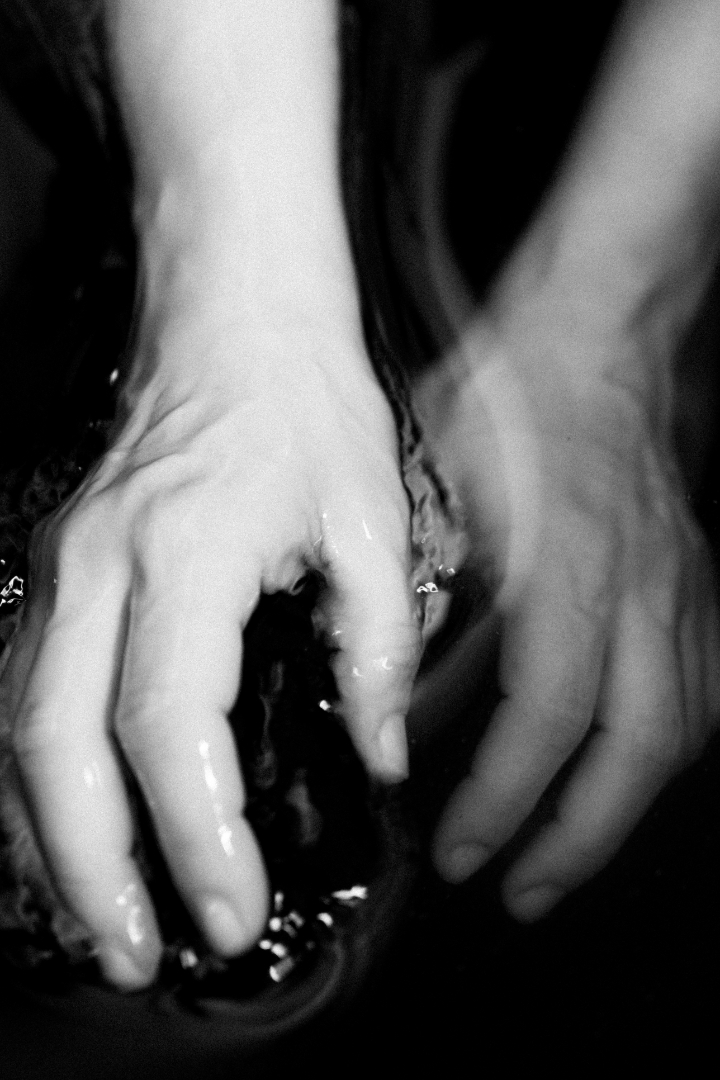
Un corpo che si è offerto all’acqua,
che non galleggia, ma accoglie.
Un corpo che non mostra, ma rivela.
Che trattiene e nel trattenere, racconta.
Il corpo ritratto è quello di una donna.
Non musa, non oggetto,
ma madre: figura archetipica che genera, trattiene, contiene.
In lei si compie il paradosso dell’abisso:
non è il vuoto che inghiotte, ma lo spazio che custodisce.
Una madre che non spiega, ma lascia intuire.
Che non grida, ma lascia risuonare.
Una madre che non ordina, ma orienta.
Non offre risposte, ma stanze in cui le domande possono respirare.
Non indica la strada: la custodisce.
Il suo corpo è una mappa che si legge solo con gli occhi chiusi,
una voce che non parla ma che si deposita come sedimento.
Bachelard ci insegna che l’acqua profonda è l’immaginazione dell’origine.
In essa sogniamo la discesa, il ritorno al grembo,
al luogo dove tutto è possibile ma nulla ancora è deciso.
L’abisso non è la morte, ma l’attesa della forma.
È la possibilità ancora indistinta, lo sguardo prima dello sguardo.
È il battito prima del cuore.
Lo spazio in cui tutte le forme sono ancora liquide,
e ogni possibilità è contemporaneamente viva e silenziosa.
È ciò che esiste prima del pensiero, prima del linguaggio, prima dell’identità.
In [a-bìs-so], il corpo immerso diventa paesaggio interiore.
Ogni piega è eco di un dentro invisibile.
Ogni porzione di pelle è un racconto non detto,
un contenuto che affiora nel contenitore.
Un atlante liquido dell’intimità. Una mappa affettiva.
Non fatto di territori o confini, ma di soglie e sprofondamenti.
Ogni tratto è un frammento di memoria corporea,
ogni macchia una traccia emotiva.
Un paesaggio non geografico ma epidermico,
dove le geografie sono fatte di pelle, pieghe, acqua e sussurri.
Questo non è un corpo da guardare.
È un corpo da abitare con lo sguardo.
Un corpo che si lascia attraversare come una preghiera liquida,
senza tempo, senza nome, senza luce.
Come una conchiglia che conserva il suono del mare
anche quando il mare non c’è più.
Una presenza fossile, ma ancora vibrante.
Un’eco che sopravvive alla fonte,
che continua a parlare anche dopo che il corpo si è ritratto.
Il ricordo di un’intimità che persiste nelle pieghe vuote,
nell’assenza che pulsa piano.
L’opera è stata presentata per la prima volta in occasione del Festival di Arti Diffuse Dio D’Acqua, a Campagna (SA).
DIO D’ACQUA Festival · Ruderi della Concezione · Campagna (SA), 2025
they say you fall into an abyss,
almost as if the inevitable were the only human, earthly
and solitary condition.
a mute gravity that cannot ask, does not know how to wait,
that gives chase dragging its legs and its promises.
broken thoughts, cracked breaths, light bodies, emptied,
rigid shells imploded right after, absent echoes, numbed,
barely rebounded.
narcissus, I cross beyond the silence, I look inside,
I pass through myself and find again everything I know how to touch,
I know how to recognize from the horror, in the error,
in depth where everything translates, everything ends, everything betrays itself.
to be born is to die. this is an abyss.
one very long second, mathematically infinite,
shamed, deflowered, felt and begun again.
like the warm, liquid humor
that stays on the inner sides of the thighs,
in the folds of the groin.
lascivious, warmed by friction,
a simple and perpetual rubbing,
an anguished, solitary recovery.
they say you end up in an abyss,
renouncing existence for presence,
feeling that it heals you only if it mortifies you.
at the end of the beginning, power remains,
that black force that tears you away from the light,
forces you into the core, stops you,
admonishes you, violent,
tireless as a presumptuous premise,
a gelatinous mixture, a tangle of advanced time.
to be born is to die. this is an abyss.
an abuse, a bundle, a folded tabloid, it strikes and cracks,
cracks and punishes.
skinned flesh, raw nerves,
consumed like a paradox of stretched instants,
an involuntary movement, a disinterested judgment.
text drawn from “Thoughts on the threshold of an open door”, never published, in perpetual progress.
The Water That Contains, the Body That Keeps
Every deep being needs a deep water.
Gaston Bachelard
Welcome into [a-bìs-so]
You do not enter a place, you enter a body.
A body that has offered itself to the water,
that does not float, but welcomes.
A body that does not show, but reveals.
That holds, and in holding, tells.
The body portrayed is that of a woman.
Not muse, not object,
but mother: an archetypal figure who generates, holds, contains.
In her the paradox of the abyss is fulfilled:
it is not the void that swallows, but the space that keeps.
A mother who does not explain, but lets you sense.
Who does not shout, but lets things resound.
A mother who does not command, but orients.
She offers no answers, only rooms where questions can breathe.
She does not point the way: she keeps it.
Her body is a map read only with closed eyes,
a voice that does not speak but settles like sediment.
Bachelard teaches us that deep water is the imagination of origin.
In it we dream the descent, the return to the womb,
to the place where everything is possible but nothing is yet decided.
The abyss is not death, but the waiting of form.
It is the possibility still undefined, the gaze before the gaze.
It is the beat before the heart.
The space in which all forms are still liquid,
and every possibility is at once alive and silent.
It is what exists before thought, before language, before identity.
In [a-bìs-so], the immersed body becomes an inner landscape.
Every fold is the echo of an invisible inside.
Every portion of skin is an untold story,
a content that surfaces within the container.
A liquid atlas of intimacy. An affective map.
Not made of territories or borders, but of thresholds and depths.
Every mark is a fragment of bodily memory,
every stain an emotional trace.
A landscape not geographic but epidermic,
where the geographies are made of skin, folds, water and whispers.
This is not a body to look at.
It is a body to inhabit with the gaze.
A body that lets itself be crossed like a liquid prayer,
without time, without name, without light.
Like a shell that keeps the sound of the sea
even when the sea is no longer there.
A fossil presence, yet still vibrant.
An echo that survives its source,
that keeps speaking even after the body has withdrawn.
The memory of an intimacy that persists in the empty folds,
in the absence that pulses quietly.
The work was presented for the first time on the occasion of the Dio D’Acqua Diffuse Arts Festival, in Campagna (SA).
DIO D’ACQUA Festival · Ruderi della Concezione · Campagna (SA), 2025
se dice caer en un abismo,
casi como si lo inevitable fuera la única condición humana, terrena
y solitaria.
una gravedad muda que no logra pedir, no sabe esperar,
que persigue arrastrando las piernas y las promesas.
pensamientos rotos, respiros agrietados, cuerpos ligeros, vaciados,
vainas rígidas e implosionadas justo después, ecos ausentes, entumecidos,
apenas rebotados.
narciso, atravieso el silencio, miro adentro,
me atravieso y encuentro de nuevo todo lo que sé tocar,
sé reconocer desde el horror, en el error,
en profundidad donde todo se traduce, todo termina, todo se traiciona.
nacer es morir. esto es un abismo.
un segundo larguísimo, matemáticamente infinito,
avergonzado, desvirgado, sentido y reiniciado.
como el humor cálido, líquido,
que permanece en la cara interna de los muslos,
en los pliegues de la ingle.
lascivo, calentado por la fricción,
un simple y perenne frotar,
un angustiante, solitario recobrarse.
se dice terminar en un abismo,
renegar de la existencia por la presencia,
sentir que solo te cura si te mortifica.
al final del principio queda el poder,
esa fuerza negra que te arranca de la luz,
te obliga al núcleo, te detiene,
te amonesta, violento,
incansable como una premisa presuntuosa,
una mezcla gelatinosa, un enredo de tiempo avanzado.
nacer es morir. esto es un abismo.
un abuso, un fajo, una revista doblada, golpea y restalla,
restalla y castiga.
piel desollada, nervios crudos,
se consumen como una paradoja de instantes estirados,
un movimiento involuntario, un juicio desinteresado.
texto extraído de “Pensamientos en el umbral de una puerta abierta”, inédito, en permanente elaboración.
El agua que contiene, el cuerpo que custodia
Todo ser profundo necesita un agua profunda.
Gaston Bachelard
Bienvenidos a [a-bís-so]
No se entra en un lugar, se entra en un cuerpo.
Un cuerpo que se ha ofrecido al agua,
que no flota, sino que acoge.
Un cuerpo que no muestra, sino que revela.
Que retiene y, al retener, cuenta.
El cuerpo retratado es el de una mujer.
No musa, no objeto,
sino madre: figura arquetípica que genera, retiene, contiene.
En ella se cumple la paradoja del abismo:
no es el vacío que traga, sino el espacio que custodia.
Una madre que no explica, sino que deja intuir.
Que no grita, sino que deja resonar.
Una madre que no ordena, sino que orienta.
No ofrece respuestas, sino cuartos donde las preguntas pueden respirar.
No indica el camino: lo custodia.
Su cuerpo es un mapa que solo se lee con los ojos cerrados,
una voz que no habla pero que se deposita como sedimento.
Bachelard nos enseña que el agua profunda es la imaginación del origen.
En ella soñamos el descenso, el retorno al vientre,
al lugar donde todo es posible pero nada está aún decidido.
El abismo no es la muerte, sino la espera de la forma.
Es la posibilidad todavía indistinta, la mirada antes de la mirada.
Es el latido antes del corazón.
El espacio donde todas las formas son todavía líquidas,
y cada posibilidad está al mismo tiempo viva y silenciosa.
Es lo que existe antes del pensamiento, antes del lenguaje, antes de la identidad.
En [a-bís-so], el cuerpo sumergido se vuelve paisaje interior.
Cada pliegue es eco de un adentro invisible.
Cada porción de piel es un relato no dicho,
un contenido que aflora en el contenedor.
Un atlas líquido de la intimidad. Un mapa afectivo.
No hecho de territorios o fronteras, sino de umbrales y hundimientos.
Cada trazo es un fragmento de memoria corporal,
cada mancha una huella emocional.
Un paisaje no geográfico sino epidérmico,
donde las geografías están hechas de piel, pliegues, agua y susurros.
Este no es un cuerpo para mirar.
Es un cuerpo para habitar con la mirada.
Un cuerpo que se deja atravesar como una plegaria líquida,
sin tiempo, sin nombre, sin luz.
Como una concha que conserva el sonido del mar
incluso cuando el mar ya no está.
Una presencia fósil, pero todavía vibrante.
Un eco que sobrevive a la fuente,
que sigue hablando incluso después de que el cuerpo se ha retirado.
El recuerdo de una intimidad que persiste en los pliegues vacíos,
en la ausencia que late despacio.
La obra se presentó por primera vez con motivo del Festival de Artes Difusas Dio D’Acqua, en Campagna (SA).